
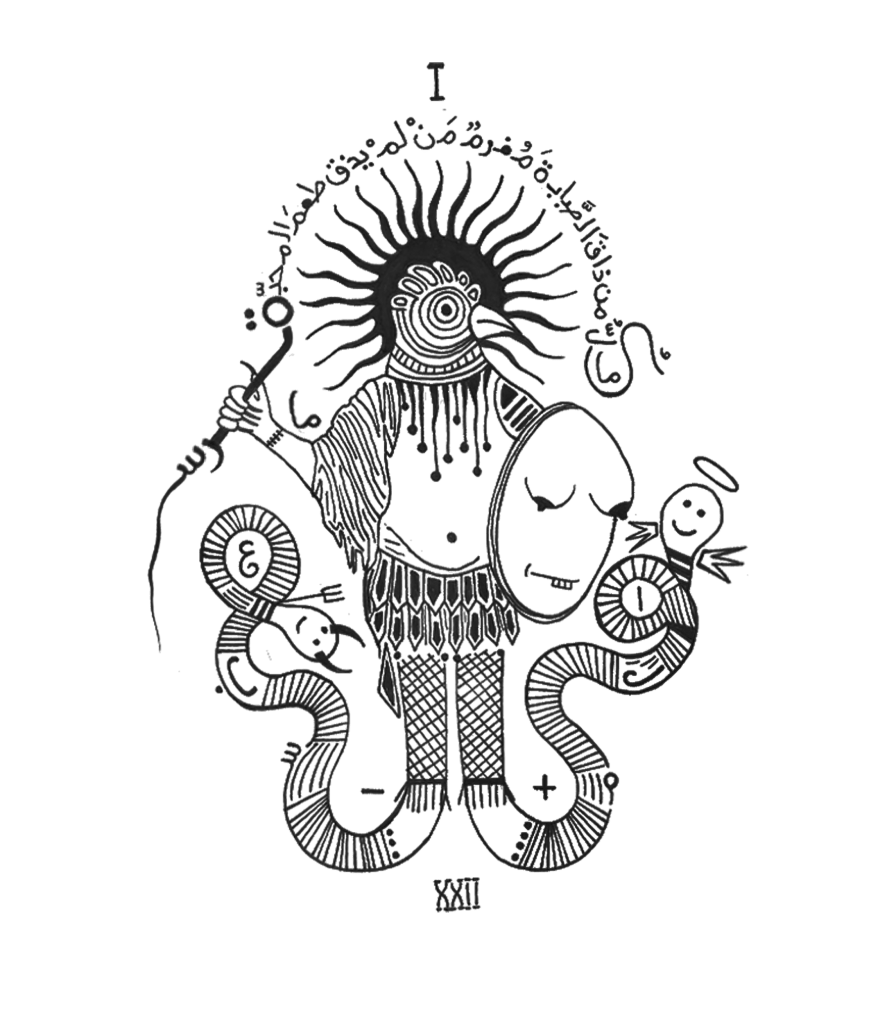
The Hint of Abraxas
Inspired by an Arabic poem by ʿAbd al-Ghanī al-Nābulusī (1641–1731) and the mythic symbol of Abraxas
This artwork brings together two distant yet quietly connected worlds — a mystical line of Arabic poetry, and the ancient, mysterious figure of Abraxas, as imagined in Demian by Hermann Hesse. The Arabic inscription reads: “Not all who feel longing are truly in love. Those who’ve never tasted love — have never truly lived.” These words open the door to a different kind of love — not the fleeting kind, but the kind that undoes and transforms. The poem, written by the 17th-century Sufi mystic ʿAbd al-Ghanī al-Nābulusī, tells of a lover who reaches toward Su’ad — a beloved who is always near, yet never quite within reach. He remembers her constantly, aches for her presence, and when he finally speaks of his pain, she offers comfort only to withdraw it. She tells him, softly but firmly: “You will never reach me.” In Sufi thought, such a beloved often represents the Divine — the hidden source of beauty that draws the soul forward through longing. The ache is not a flaw in love; it is its doorway. The central figure in the image is inspired by Abraxas — a symbol of wholeness that holds together light and dark, birth and death, sacred and profane. In Demian, Abraxas is not a god of clarity or comfort, but of truth — one who invites us to accept contradiction, to see the divine in both shadow and radiance. The artwork lives in that space between — between memory and myth, desire and denial, form and formlessness. It does not offer an answer. It is only a hint. And perhaps that is enough.
Barakat
 BARAKAT