
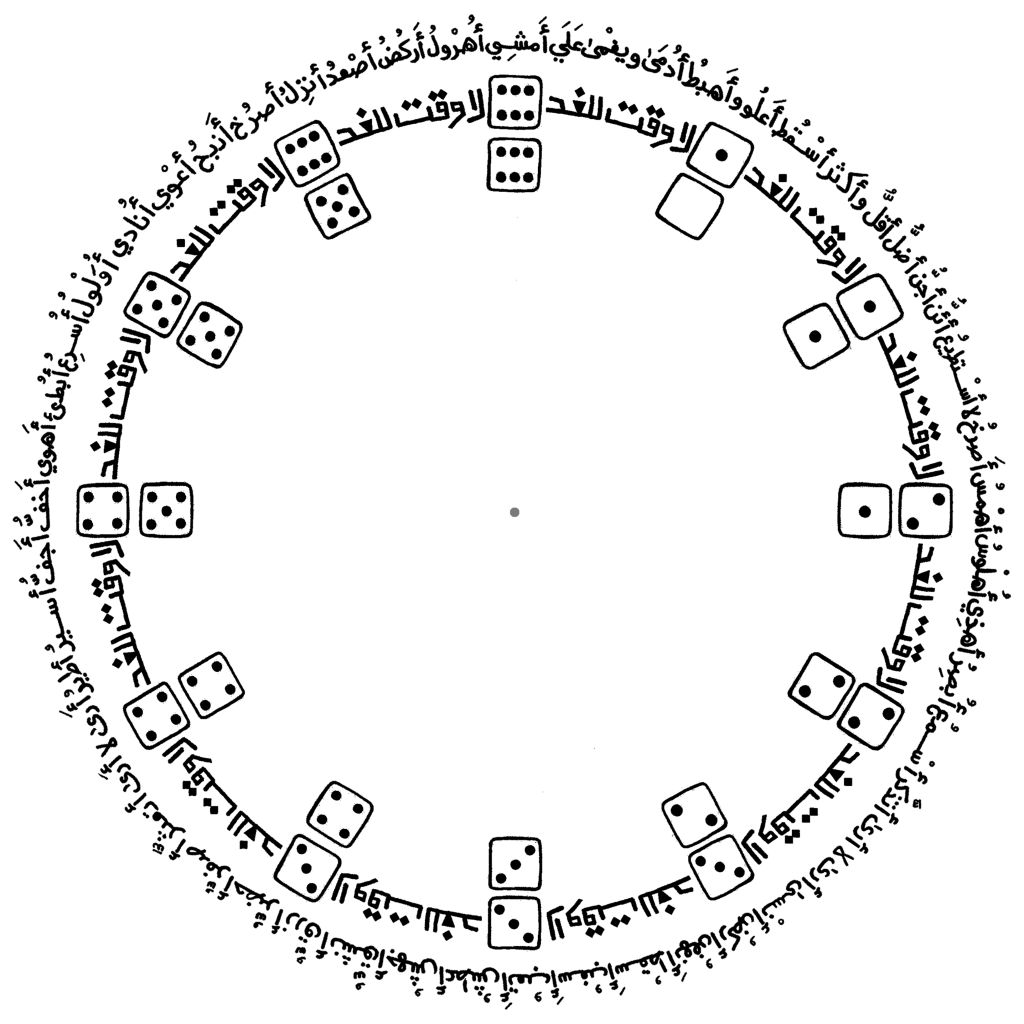
NO time for Tomorrow .
We hear a lot of those trendy sentences — time is an illusion, time is relative, be in the now… — until they almost become clichés and lose their meaning. But wait a moment: how would a real clock look? A clock that is trying its best to be honest about the stream of events and changes we conventionally name “time.” A clock that is functional, yet refuses to tell ordinary time.
Instead, it echoes the voice of the genius Palestinian poet Mahmoud Darwish, who questioned all of this deeply and poetically after a near-death experience, in which he witnessed the mortality of man and the fragility of our reality of words, concepts, and obsession with control. The circle of hours is replaced with fragments of his poem, where action dissolves into action — walking, running, falling, rising, seeing, not seeing, remembering, forgetting.
Here, the clock is no longer a machine for measuring minutes, but a mirror of human restlessness. The dice-like symbols in place of numbers remind us that life is thrown by chance, and that time itself may be nothing but a game we are caught inside.
At the center, the hands keep moving endlessly, yet they point to no final answer. They mark not hours but states of being: exhaustion, thirst, delirium, hope, collapse, and return.
This piece invites us to pause, to recognize that perhaps there is “no time for tomorrow” — only the fragile, fleeting presence of now.
Watch a musical interpretation
Barakat
 BARAKAT