The cart
This work is inspired by one of the spiritual and philosophical ideas associated with George Gurdjieff, and draws from a range of ancient spiritual traditions and inner teachings that he gathered and rearticulated in a modern form.
It reflects a central aspect of the “Fourth Way,” which emphasizes conscious self-observation and the necessity of harmony between the three centers of the human being: the moving, the emotional, and the intellectual.
It emerges from a view of the human not as a unified self, but as a composite of forces that do not naturally function in balance. The body moves, the emotions react, and the mind interprets and attempts to lead often without true coordination.
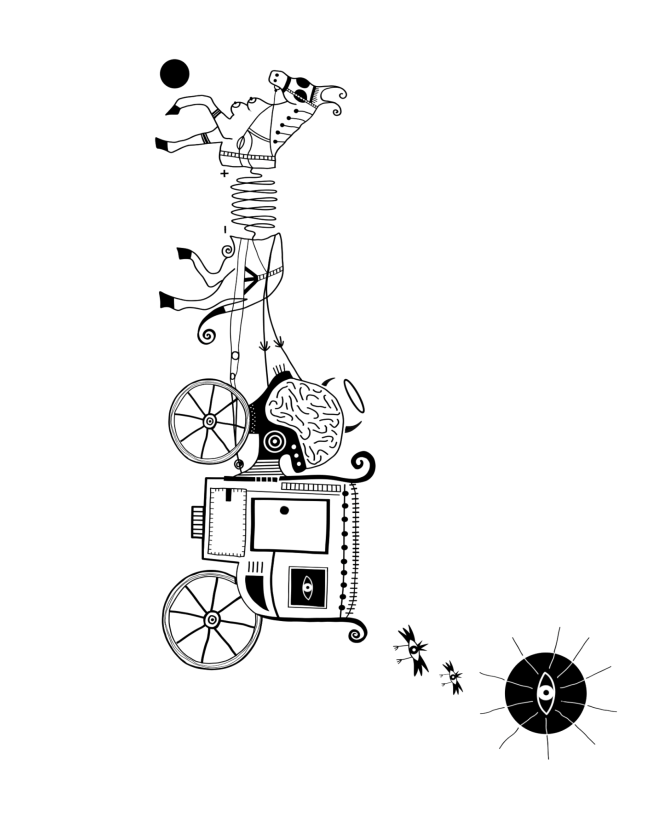
This drawing is an attempt to give form to this condition, not as an explanation, but as an invitation. It proposes an image of a being that moves, thinks, and perceives, yet is not certain it is the one in control.
The work invites the viewer not only to understand, but to observe, to trace this structure within themselves, and to recognize its movement inwardly.
________________________
What follows is my own poetic attempt to approach this idea, shaped by my humble and somewhat distorted recent understanding :
“My horse is blind, yet curious and lustful.
It loves to roll balls in front of it, to push things just to see them move. That movement stirs a joy within it, the joy of being alive.
alive, and nothing more.
My horse is made of flesh and blood, yet in truth it runs on electricity. electricity borrowed from the sun, then forgotten, an electricity of contradiction, of primal duality and so my horse always feels split in two.
Perhaps it is that very division which drives it forward.
Forward, backward… it doesn’t matter. these are only names. names can’t be real destinations.
The mind loves to sit in the front of the carriage,
a place that gives it the pleasure of control.
The mind is narcissistic by nature,
vain, confident in its abilities.
It leads the horse to the right and to the left,
imagining many destinations, hallucinating arrivals. Each day it proposes a new one and believes it is THE ONE, then on the next day the mind changes its mind.
that poor mind has no real destination.
It simply wanders, enjoying the fresh air of vanity, intoxicates itself with its own projections of direction.
And although it is the Imam of the mad
and despite its infinite limitation and dullness,
it constantly appeals to logic
accusing every opponent of foolishness and idiocy. Opponents whom it constantly creates and debates.
It imagine them then loses itself in arguments with them
justifying its direction.
Yet, despite all this,
there is a subtle feeling within it,
deep, deep, deep inside,
that somewhere there is a place
a magical spot.
When reached,
the horse will become a unicorn,
it will fly above rainbows, beyond good and evil,
there in the heart of the ocean of eternal ecstasy.
The carriage is made of a mixture of wood.
Some of it comes from the tree of the first sin,
which God did not hesitate to cut down after the fall.
Some comes from the remains of Noah’s Ark,
cut by cave hermits after the flood,
and some from the wood of the cross.
The carriage is coated in gold and blood
the blood of the redeeming Son.
It shines with splendor,
yet inside it is absolute darkness,
complete opaque.
Blackness
emptiness and silence.
Nothing…
absolutely nothing.
the womb of nothing.
within that,
an eye.
An eye with no face,
no eyelids,
no lashes.
A naked eye,
suspended in the void,
Seeing, and nothing more.
It looks out from the window of the carriage
knowing exactly where it is going
dancing its destination beyond the four directions,
and outside of time.
So it arrives at each moment, then evaporates.
Touched by the lightness of spirit,
it rises from one sky to another,
understanding, and understanding
the meaning of understanding, then forgetting all about it,
rising and rising,
until its own light strikes it blind.
It became the sun,
it became the queen,
and there was no longer any need for sight,
for there was nothing but it.
Barakat